
uPVC Door Lock Mechanism Problems: Parts and Repair Options
A uPVC door lock is a system: a cylinder takes the key, a gearbox transfers movement, and a multipoint strip carries the locking points along the door edge. Identifying which part is involved is more useful than ordering something simply labelled “a uPVC lock”.
The Parts of a uPVC Door Lock, Named
People often use “barrel”, “gearbox” and “mechanism” for the same thing. They are different components, and a fault in one does not automatically require replacing the others. This guide from PDS Locksmiths Birmingham explains their relationships before looking at identification and repair decisions. For other door arrangements, start with our guide to UK door lock types.
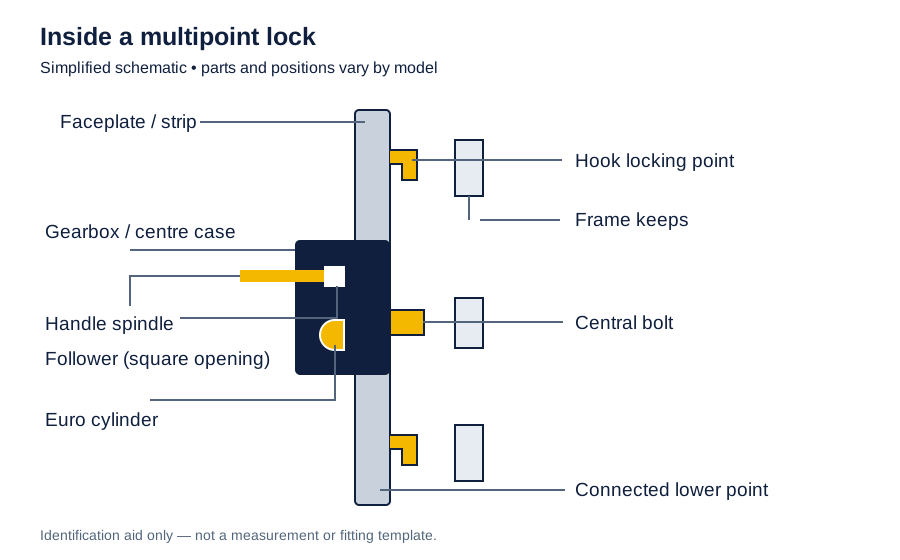
The Strip and Its Locking Points
The visible metal band on the door edge is the faceplate. Behind it, the mechanism connects the central case to locking points above and below. Those points engage with matching fittings on the frame, called keeps. A lock that moves freely away from the frame can still struggle if its points do not meet the keeps correctly.
- Hooks pivot into matching keeps.
- Rollers move into their receivers and can contribute to seal compression; adjustment depends on the design.
- Mushroom cams have an enlarged head that engages a shaped keep.
- Pinbolts extend into corresponding receivers.
- Deadbolts are solid bolts; their shape and position vary.
A door may combine several of these. Do not assume two strips are interchangeable because they have the same number of hooks. Their positions, travel and matching keeps also matter.
The Gearbox, Cylinder and Handle
The handle spindle fits into the follower, the shaped opening in the central gearbox or centre case. On a lever-operated system, lifting the handle drives the mechanism. The euro cylinder passes through the central case; its cam operates the locking function when the key turns. A cylinder problem and a gearbox problem therefore call for different assessments.
| Part | What acts on it | Its role |
|---|---|---|
| Spindle and follower | Handle movement | Transfer rotation into the central case |
| Gearbox / centre case | Handle and, depending on design, cylinder | Operates the connected locking mechanism |
| Euro cylinder and cam | The correct key or thumb turn | Controls locking and unlocking functions |
Changing a cylinder does not normally mean changing the full strip. Our uPVC cylinder-change guide explains the distinction and the limits of a straightforward barrel replacement.
Four Supplier Categories—and an Important Difference
Parts catalogues may list full locks, gearbox centre cases, overnight locks and automatic or “slam shut” mechanisms. These are purchasing categories, not four equivalent operating modes. In particular, an overnight lock is a temporary securing product. It is not the name for every door whose handle must be lifted before turning the key.
| Category | What it means | Repair implication |
|---|---|---|
| Full multipoint lock | Central case and connected strip/locking points | Match the complete arrangement |
| Gearbox centre case | A separate central driving unit | Only usable where the mechanism accepts a compatible replacement |
| Overnight lock | A temporary securing product while permanent work is arranged | Suitability and limitations need assessment |
| Automatic mechanism | Locking points engage as the door closes, according to its design | Operation and replacement must match the specific system |
Full Lock Versus Gearbox Centre Case
A complete replacement changes the strip and its connected components. A gearbox-only replacement retains compatible serviceable parts. Not every mechanism has a replaceable centre case, and an available case that looks similar may have different dimensions or operation. The choice depends on the existing mechanism, damage and replacement availability—not simply on which item is cheaper.
Lever-Operated Versus Automatic Locking
Many lever-operated doors require the handle to be lifted before the key secures the mechanism. Automatic systems behave differently. Winkhaus distinguishes lever-operated, key-operated and automatic systems; use the instructions for the fitted model rather than assuming one sequence applies to all.
A door that secures itself when it closes can leave you outside without a key. If that has happened, see house lockout assistance. Do not repeatedly close a faulty door to test it when that might leave you locked in or out.
How a Mechanism Is Identified and Matched
Begin with any name, number or logo stamped on the faceplate. The door manufacturer's name alone is not enough: door fabricators can use hardware from different suppliers. Record visible markings without dismantling the mechanism, and distinguish a handle brand from a lock brand.
A useful identification record combines markings, dimensions, locking-point layout and operating type. Home Secure's identification guide explains the gearbox/full-lock distinction and why PZ and backset matter. A supplier's drawing should settle exactly where each measurement starts and ends.
The Measurements to Record
| Measurement | What to identify | Why it matters |
|---|---|---|
| Backset | Distance from the specified faceplate reference to the spindle/cylinder centre line | Locates the central case within the door |
| PZ / centres | Centre of the handle spindle to centre of the cylinder's circular key-plug portion | Matches the handle and cylinder positions |
| Faceplate width and length | Width of the edge strip and its overall length | Fits the door's prepared channel |
| Screw centres and case dimensions | The fixing positions relevant to the exact component | A similar-looking case may not attach correctly |
| Locking-point positions | Type and distance of each point from a consistent reference | Matches the frame keeps and door preparation |
“Screw centres” can describe different fixings, including handle screws. Always identify which screws a diagram refers to. Do not order from a single measurement or treat catalogue size ranges as universal standards. Also check latch handing, spindle arrangement and any model-specific requirements. See LockShop Direct's measurement guide for a supplier illustration.
Record the Locking-Point Layout
If the door opens normally and can be kept safely open, photograph the whole edge and close-ups of the markings and central case. Note how many hooks, rollers, mushrooms and bolts are visible, where they sit and the shape of their keeps. Keep fingers away from moving parts. Do not force the handle or trigger an automatic mechanism just to make a photograph.
Write down whether you normally lift the handle, turn a key directly or close an automatically locking door. These observations help a supplier or locksmith identify the system. They do not prove what is wrong with it or guarantee a replacement can be fitted on the first visit.
Which Part Could Be Causing the Problem?
Symptoms overlap. A handle that feels stiff can reflect alignment, wear or a mechanism fault. A key that resists turning can involve the key, cylinder or load from the door. The table is a description aid rather than a diagnosis or a ranking of the most likely failures.
| Observation | Parts worth assessing | Next guide |
|---|---|---|
| Handle loose, slack or unusually stiff | Fixings, spindle, follower, gearbox and alignment | Door will not lock |
| Some points move but do not engage the frame | Strip, keeps, hinges and door position | Locking and alignment checks |
| Door remains shut despite normal operation | Mechanism, latch and door/frame condition | Door will not open |
| Key sticks or will not turn | Key, cylinder and load on the locking system | Stuck-key diagnosis |
| Key has snapped | Fragment position and underlying cylinder/mechanism condition | Broken-key guidance |
Report changes you noticed before the failure: extra force, intermittent operation, scraping or a loose handle. Avoid assigning a cause from a noise alone. A recording of how the fault developed is more useful than an unsupported guess that “the gearbox has gone”.
Gearbox Alone, or the Whole Strip?
A separate gearbox may be appropriate when that is the failed component, the mechanism permits separate replacement, a compatible case is available and the rest remains serviceable. A full strip may be needed if multiple components are damaged, the system is obsolete or no suitable centre case is available.
The remaining hooks, connectors and frame keeps should still be assessed. Replacing the gearbox while leaving severe misalignment unresolved may leave the system under strain. Conversely, replacing every component is not automatically justified by a stiff handle. The repair-versus-replacement guide explains how condition changes the decision.
Ask what has failed, what will remain and how compatibility will be checked. An explanation of the proposed work is more useful than a promise to fit a “universal” part. See our locksmith pricing guide for questions to ask about labour, parts and the scope of a quotation.
What Helps a Mechanism Keep Working?
Use the door's normal operating sequence and take increasing resistance seriously. Follow the manufacturer's maintenance instructions for the specific hardware. Cylinder care and lubrication of exposed mechanical parts may require different products; spraying the same substance into every opening is not a maintenance plan.
Do not force a handle, use the key to pull a heavy door or keep lifting a dropped door by its handle. Arrange assessment when operation becomes unreliable. Stop using a bending key. A replacement cylinder's security rating is a separate question from whether the mechanism works: our anti-snap cylinder guide explains that distinction.
Get the Mechanism Assessed in Birmingham
Tell us whether the door opens, whether it can be secured, what the handle does and what the key does. PDS Locksmiths Birmingham provides uPVC door lock assessment and repair; for other door types, see door lock repair. We have no call-out charge and explain proposed work and pricing before it proceeds. Call 0121 400 0413.
Frequently Asked Questions
Is the name on the handle the lock manufacturer?
Not necessarily. A door can combine a handle, cylinder and mechanism from different manufacturers. Record markings on the faceplate and visible hardware separately. Matching the mechanism needs more than the brand on the handle or the name of the company that originally supplied the door.
Does a higher hook count mean a better replacement?
Not by itself. The replacement must suit the door, frame keeps and original locking arrangement. Hooks in the wrong positions will not solve a compatibility problem. Security depends on the complete fitted system, not simply a count of the visible locking points.
Can every multipoint gearbox be replaced separately?
No. It depends on how the mechanism is constructed, whether the remaining parts are serviceable and whether an exact or approved compatible case is available. Some faults require a full mechanism; others may be resolved by a component change or adjustment. Inspection distinguishes those cases.
How long should a mechanism last?
There is no single lifespan that applies to every model and door. Use, maintenance, installation and alignment all affect wear. A sudden change in resistance or reliability deserves attention even on relatively new hardware; age alone does not establish which component needs replacing.
Will a mechanism with the same backset fit?
Backset is only one measurement. PZ, case dimensions, faceplate, fixings, locking-point positions and operating type also matter. Match against the exact product information rather than relying on one dimension or a photograph that only shows the middle of the strip.
Is the door secure if only some locking points engage?
Do not assume it is secured as intended. Partial engagement can mean a fault or misalignment and should be assessed. Avoid repeatedly forcing the handle to make the other points move. Explain which points appear to engage and whether the door currently locks when arranging help.
Does a new mechanism mean new keys?
Not always. The cylinder and mechanism are separate components, and a compatible, serviceable cylinder may remain. If the cylinder is damaged, incompatible or being changed because keys are unaccounted for, new keys may be needed. Ask which components the proposed work includes.